


Don't let pain keep you from doing what you love. Our shoulder specialists can help.
Why choose MedStar Georgetown University Hospital?
Our hospital is part of MedStar Orthopaedic Institute, the Washington, D.C. region’s largest and most experienced team of orthopedic shoulder specialists.
Our fellowship-trained shoulder specialists care for a wide range of disorders and offer the most advanced shoulder treatments and surgical procedures to relieve everything from a sports-related injury to a degenerative disease.
Patient safety is our priority
MedStar Orthopedic Institute is committed to providing the care you need in an appropriate and safe setting. That’s why we’re offering both video and in-person visits.
In some cases, an in-person visit may be best. We continue to focus on providing a safe, clean, and secure environment for you to receive your care. Learn more about our safety practices here.
-
Rotator Cuff Injuries
Rotator cuff injuries may be caused by tendinitis, tendinosis, bursitis or a rotator cuff tear. Once our specialists diagnose your specific rotator cuff condition, we’ll aim to ease your pain and restore your strength and range of motion through nonsurgical treatments that may include:
- Avoiding activities that cause your pain
- Over-the-counter or prescription anti-inflammatory medications
- Applying ice to the painful area nightly
- Steroid injections
- Physical therapy, including stretching and exercises designed to restore strength and range of motion in your arm and shoulder
If these treatments do not relieve your pain, surgery may be needed. Our surgeons offer minimally invasive surgical techniques that use smaller incisions and sophisticated instruments to repair your injury with a faster, less painful recovery than traditional surgery. They also specialize in innovative procedures including arthroscopic rotator cuff repair. Learn more about it here. Recovery from arthroscopic rotator cuff surgery generally involves protecting your arm in a sling for about a month, followed by about five months of physical therapy to regain strength and range of motion. Your surgeon will discuss the specific program designed for you prior to your procedure. -
Shoulder Arthritis
Treatment for shoulder arthritis depends on whether you suffer from osteoarthritis or rheumatoid arthritis, as well as the severity of your disease. Individualized treatment plans are designed to ease your pain and improve your ability to use your arms. Nonsurgical options may include:
- Resting your arm and avoiding activities that cause your pain
- Over-the-counter or prescription anti-inflammatory medications
- Applying heat or ice to your shoulder
- Steroid injections
- Physical therapy, including exercises designed to restore strength and range of motion in your arm and shoulder
If these treatments do not relieve your pain, you may require surgery. Our surgeons are experienced in the most advanced and innovative surgical procedures for shoulder arthritis treatment. -
Shoulder Dislocation
A shoulder dislocation occurs when the top of the upper arm bone moves out of the shoulder joint socket and is usually caused by falls, car accidents or strong contact during sports. Those with a dislocated shoulder may experience swelling, numbness, weakness, bruising, pain, instability and even muscle spasms.
To treat a dislocated shoulder, a physician uses a process called closed reduction that places the upper arm back into the socket. Pain relief is almost immediate. After treatment, physicians typically recommend that the shoulder be immobilized in a sling or other device for a few weeks. For patients with recurrent dislocations, surgery is often recommended to help keep the shoulder in place. -
Shoulder Fractures
Fractures (broken bones) that affect the shoulder typically involve the clavicle (collar bone), proximal humerus (upper arm bone), or scapula (shoulder blade). Clavicle and proximal humerus fractures are often caused by falls, collisions, or motor vehicle accidents. The scapula is not as easily fractured because of the protection provided by the chest and surrounding muscles. Scapula fractures are usually caused by more severe traumas and chest injuries.
Shoulder fracture symptoms include pain, swelling and bruising of the shoulder area, inability to move the shoulder without pain, a bump or disfigurement at the site of the fracture, and a snapping or cracking sensation when moving the shoulder.
Most shoulder fractures can be treated by setting the joint into place and using a sling or strap to immobilize it. After a period of healing, rehabilitation exercises can help patients build strength and regain range of motion. In more severe cases, in which fracture fragments have been displaced from their normal position, surgery may be necessary to realign the shoulder. -
Shoulder Instability
Shoulder instability develops when your muscles and ligaments are not strong enough to hold your shoulder bones securely in the socket. This can lead to multiple painful shoulder dislocations or prevent you from using the shoulder or lifting your arm.
Most cases of shoulder instability respond well to conservative treatment involving intensive rehabilitation exercises and physical therapy to strengthen the muscles that help hold the shoulder in place. Additionally, our specialists also recommend taking nonprescription pain and anti-inflammatory medication and avoiding activities that have previously resulted in shoulder dislocations.
In cases where nonsurgical methods are unsuccessful, our surgeons offer the most advanced surgical techniques to help regain shoulder function, including:
- Arthroscopic Bankart repair
- Open Bankart repair
- Coracoid transfer for shoulder instability
-
Shoulder Separation
Shoulder separation often is confused with shoulder dislocation, but the two are very different injuries. Shoulder separation occurs when the connection between the shoulder blade and collarbone is disrupted. Typically, this injury occurs after a fall onto the shoulder, which is common in sports.
Treatment depends upon the severity of the injury. Physicians categorize shoulder separation into six levels. Depending upon the severity level of your shoulder separation, treatment can range from rest, ice and a sling to our most advanced surgical procedures.
-
Frozen Shoulder
Frozen shoulder occurs when the capsule of connective tissue that surrounds the shoulder thickens and contracts, leading to stiffness and pain from restricted movement.
The condition generally affects adults ages 40 to 60 and can be caused by diseases such as diabetes, hypothyroidism, hyperthyroidism, Parkinson’s, or cardiac disease. It can also result from immobilizing the shoulder too long after an injury, which is why a vital part of any shoulder recovery is physical therapy.
Physicians typically treat this condition with anti-inflammatory medication and physical therapy, which is successful in 90 percent of cases.
For those who don't experience relief after physical therapy, surgical procedures are available to help to regain motion
Meet Frank and his Aunt Virginia – shoulder replacement recipients
When Frank decided to seek care from Dr. Brent Wiesel, his shoulders were in bad shape. “His symptoms were worse on the left side, so we started there,” says Dr. Wiesel.
Incredibly, despite the severity of Frank’s symptoms, he was back on the golf course for an annual trip to South Carolina a mere two months following his surgery. “I wasn’t 100 percent, but I could play a short round. That trip was important to me,” he says.
Next up was Aunt Virginia, who suffered from shoulder pain so severe that the cooking enthusiast could barely eat, let alone cook.
Some surgeons hesitate to undertake this kind of surgery when the patient is considered “too old.” Dr. Wiesel did not find Virginia’s age a stumbling block. After their surgeries, both Frank and Virginia received physical therapy and wore slings for six weeks.
“Shoulder replacement surgery has one of the quicker recoveries for joint replacements,” says Dr. Wiesel. “Although most people regain full function after about four months,” he says, “patients continue to improve for about a year and a half. Immediately, though, their pain is improved.”
Today, both Virginia and Frank are back. Back to cooking, back to golfing.
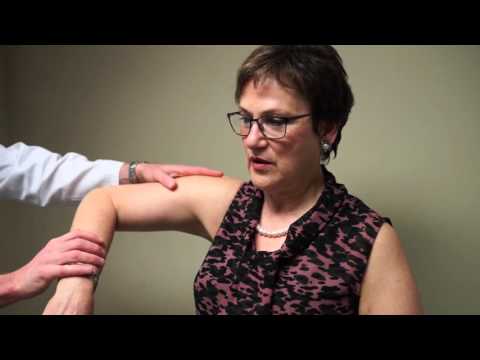

Meet Betsy Bassan — Rotator Cuff Patient
Betsy Bassan of Maryland runs her own company and leads a busy life that includes tennis and trips to the gym. When a torn rotator cuff began to slow her down, she sought help with the MedStar Orthopaedic Institute at MedStar Georgetown University Hospital and Dr. Brent Wiesel. Watch Betsy tell her story of treatment and recovery.
Brent B. Wiesel, MD
Dr. Wiesel is chief of the shoulder service at the MedStar Georgetown Orthopaedic Institute, and he performs surgery at MedStar Georgetown University Hospital.
Dr. Wiesel developed his interest in shoulder disorders after injuring his shoulder preparing for the 1996 Olympics as a member of the USA Canoe/Kayak whitewater slalom team. His injury and subsequent two surgeries prevented him from competing in the Olympics, but he returned to the sport recreationally and went on to medical school and residency at the University of Pennsylvania. He had additional training in shoulder and elbow surgery at the Rothman Institute in Philadelphia.
As part of the shoulder service team, Dr. Wiesel is also involved in research on advancing treatment for shoulder and elbow disorders.